Why this comparison matters
Roofing contractors and adjusters often ask the same question: should they continue relying heavily on manual roof measuring, or should they adopt aerial roof measurements as a primary workflow? The answer matters because measurement is one of the first bottlenecks in the estimating process.
When a team measures manually, it gains direct field input, but it also takes on travel time, scheduling complexity and added operational effort. Aerial roof measurements offer a different path by allowing the business to begin with a structured report produced from quality imagery and tracing workflows.
What are aerial roof measurements?
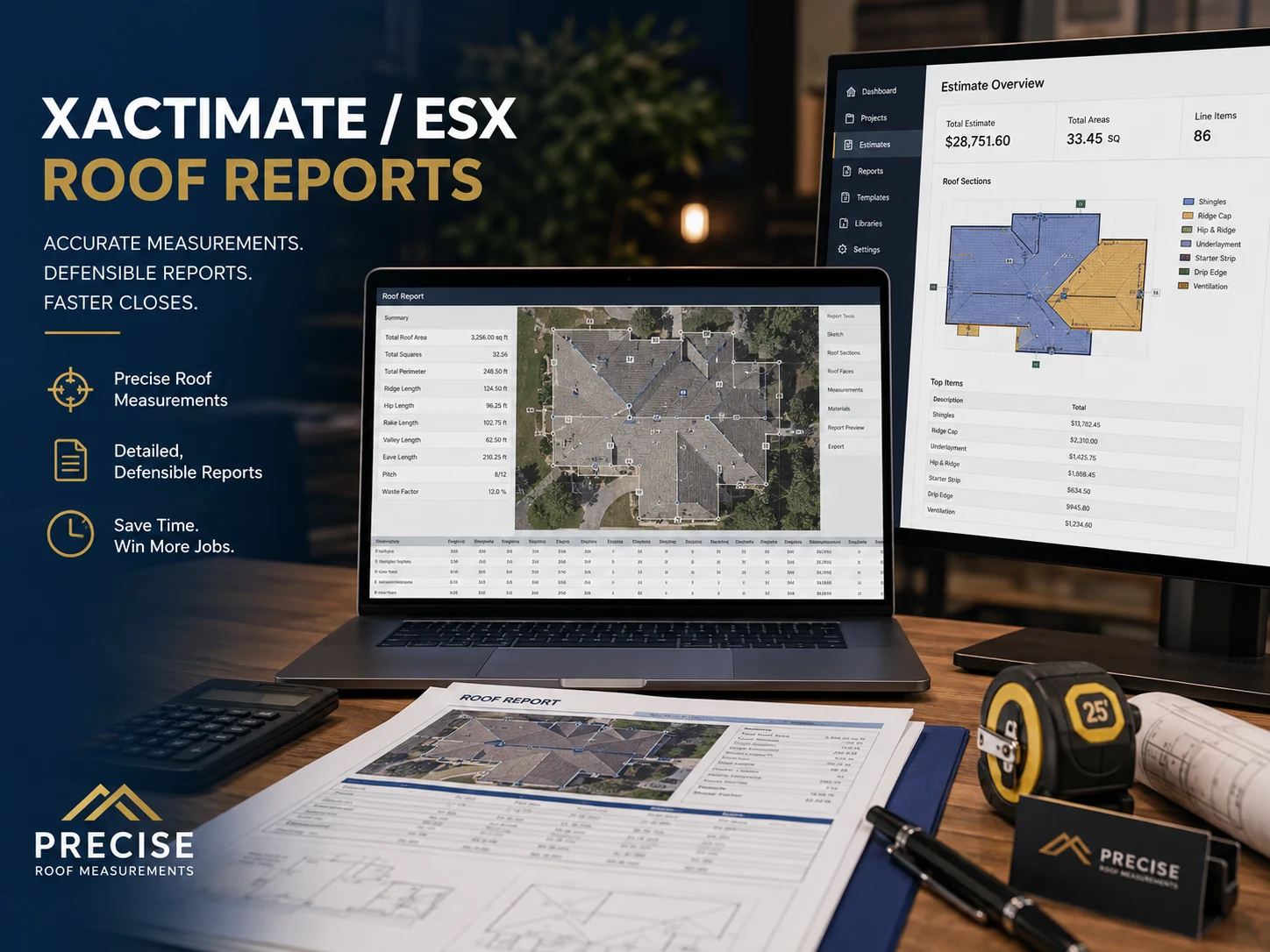
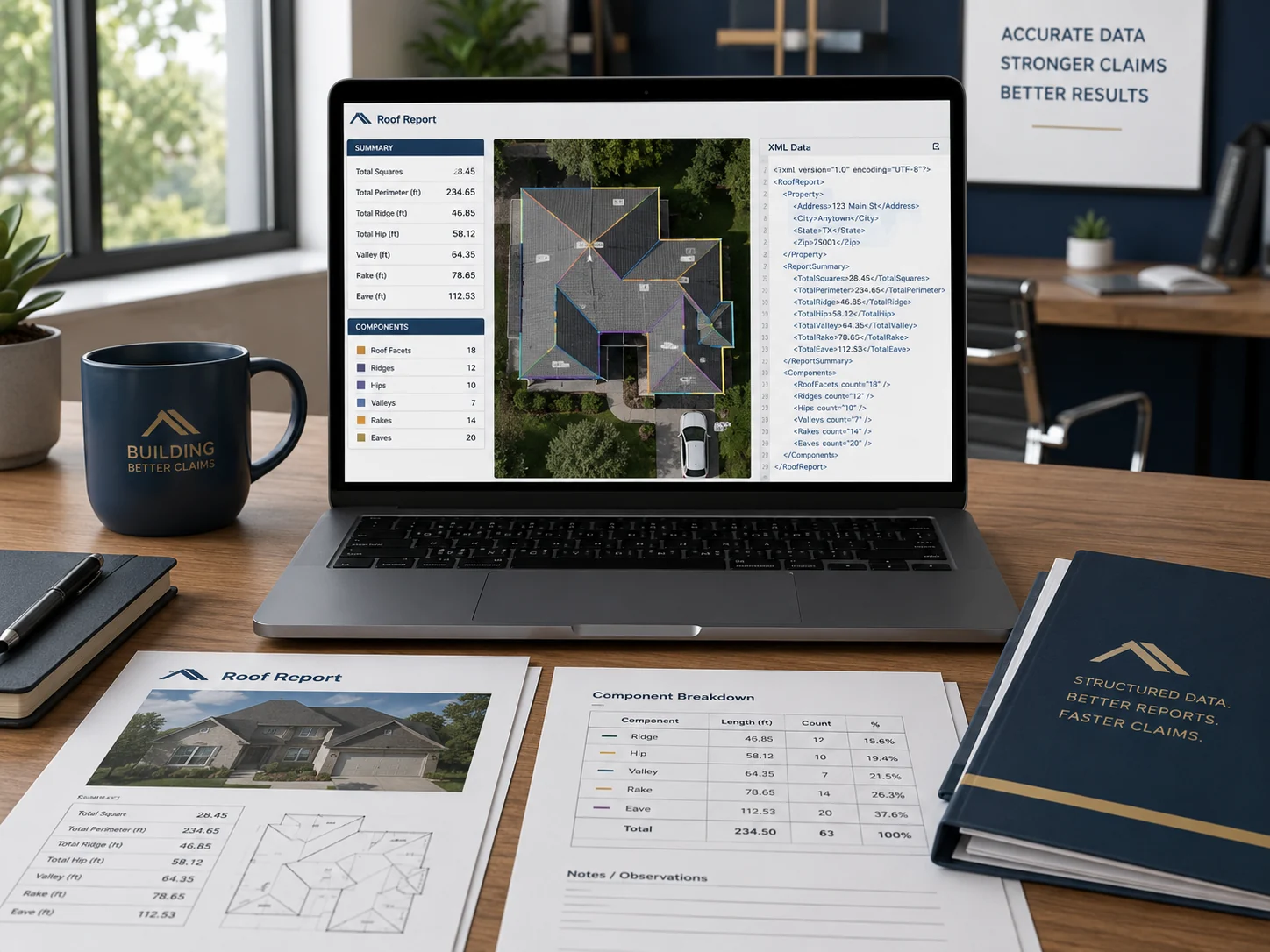
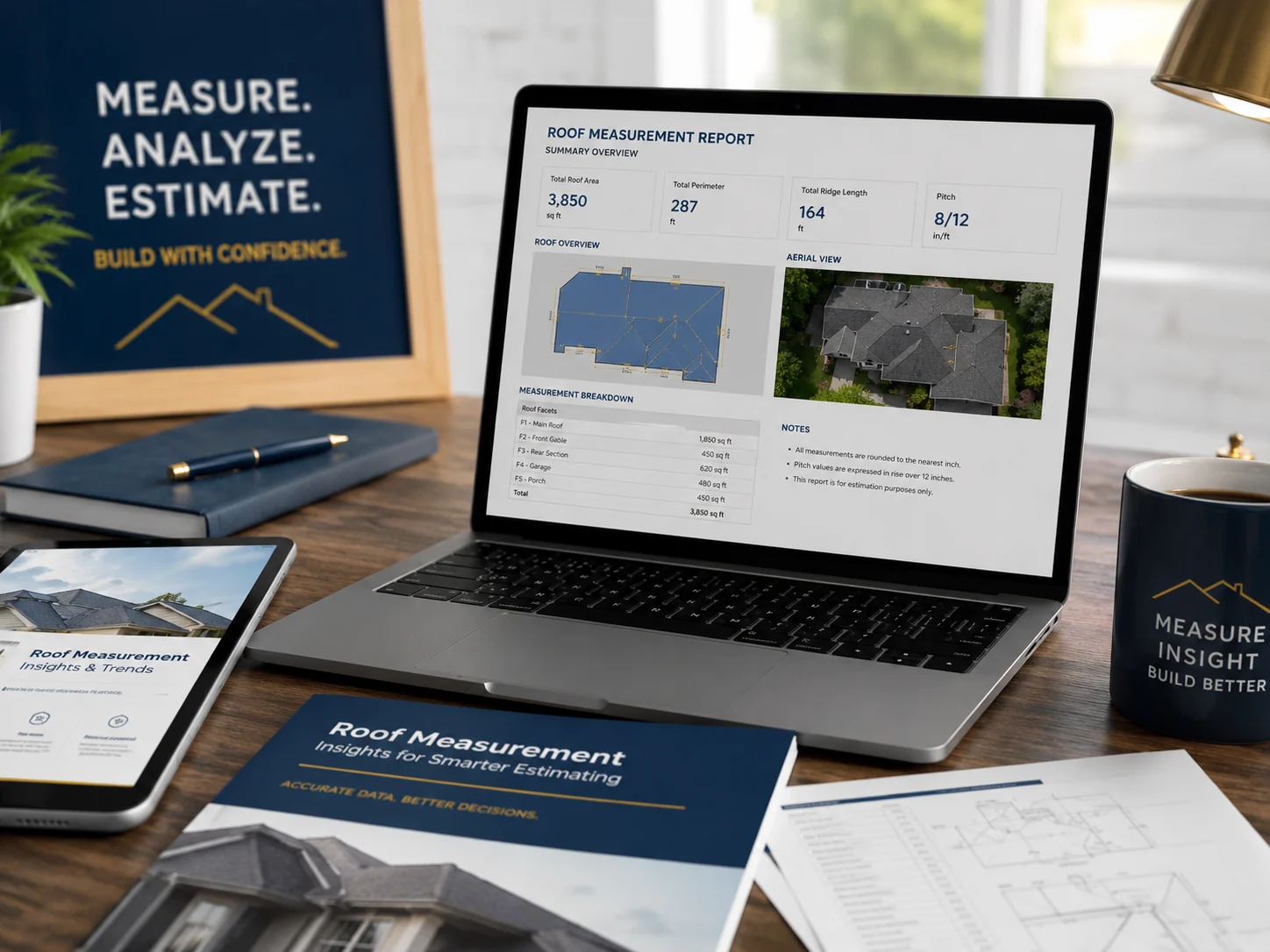
Aerial roof measurements use overhead imagery and roof-tracing methods to estimate roof geometry, areas, pitches and linear measurements without requiring a person to climb the roof for the first measurement step. When handled professionally, the result is a report that can support estimating, documentation and planning.
This approach is popular because it speeds up the front end of the job. Instead of sending someone out only to gather basic dimensions, the business can review an organized report and begin scoping much sooner.
What is manual roof measuring?
Manual roof measuring refers to taking measurements on-site, whether from the ground, ladder or the roof itself. It can be useful in certain circumstances, especially when unusual site conditions or direct field verification are necessary.
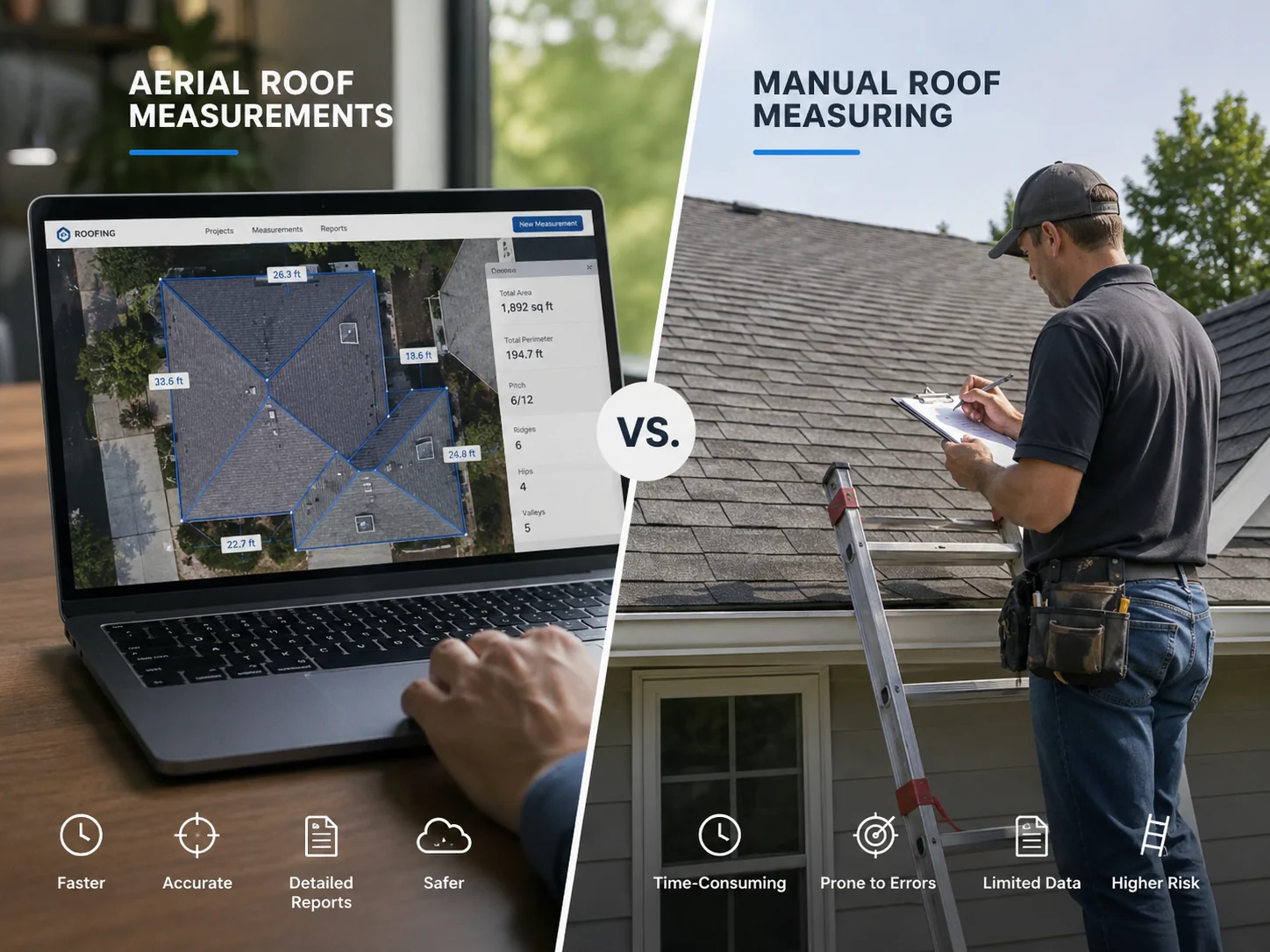
However, manual measuring requires more staff time and creates more friction in the early workflow. Someone has to travel, access the property, document the data and then translate those notes into a usable estimating format. That effort adds cost even when the process goes smoothly.
How the two methods compare on speed and safety
Aerial measuring generally wins on speed. Office-based measurement support lets estimators or coordinators begin reviewing roof geometry without travel delays, which can shorten the time from inquiry to estimate.
It also wins on safety in many cases. Fewer unnecessary climbs mean less exposure. Teams can still perform field visits later when required, but the initial measurement stage no longer has to create avoidable physical risk.
What about accuracy and scalability?
Accuracy depends on process quality. A careless manual measure can be wrong, and a poor aerial report can be wrong. The more useful comparison is between a disciplined aerial workflow and the actual field conditions under which teams operate. When aerial reports are hand-traced and reviewed carefully, they deliver strong practical accuracy for many jobs.
Aerial workflows also scale more effectively. If your company suddenly has to handle more estimates or more storm-related claims, an aerial-first approach is usually easier to expand than a field-first system that depends entirely on manual measuring.
When each method fits best
Aerial measurements work best for fast estimate preparation, lead response, storm-volume support and businesses that want consistent measurement processes. Manual measuring works best as an exception tool when the job requires special on-site verification or when field conditions demand a closer look.
For many companies, the best answer is a hybrid system: start with aerial roof measurements and use manual verification only where needed. That preserves speed without giving up flexibility.
How to decide which measurement method to use on a real job
Aerial roof measurements are usually the better starting point when the priority is fast estimate preparation, reduced travel and repeatable reporting. Manual measuring becomes more valuable when field conditions cannot be confirmed from imagery, when the roof has been modified recently or when the contractor needs direct verification for a specific detail.
Many roofing companies use a hybrid rule: order the aerial report first, compare it with inspection photos, and send someone back for field verification only if a section remains unclear. This protects estimator time while keeping the team flexible on unusual properties.
The right method is therefore not about choosing technology over field knowledge. It is about using field labor where it adds the most value and using aerial measurements where they can remove unnecessary work.
Examples of jobs where aerial or manual measuring may be the better fit
A standard suburban asphalt-shingle roof with clear imagery is a strong candidate for an aerial-first workflow. A contractor can receive the report, prepare the estimate and verify visible damage during the inspection without spending additional time manually measuring every roof edge.
A property with heavy tree cover, a recent addition, multiple hidden low-slope sections or poor imagery may deserve more field verification. Likewise, a complex commercial roof with parapets and equipment areas may require a combination of aerial measurement and site-specific confirmation.
Using job type and image quality as the decision criteria is more practical than forcing every project through the same measuring process.
Where the real cost difference appears between aerial and manual measuring
The visible cost of manual measuring is not limited to the time spent on the roof. Travel, vehicle expense, scheduling, ladder setup, safety preparation and the time required to organize field notes all contribute to the true cost of the measurement process. When a skilled estimator is also the person doing the measuring, the opportunity cost is even higher because that employee is not writing estimates during that time.
Aerial measurement services shift those tasks into a centralized workflow. The contractor still pays for the report, but the internal team gains back time that can be used for sales, estimating, supplements or production planning. The financial advantage becomes easier to see when the company measures dozens or hundreds of properties rather than evaluating a single roof in isolation.
For smaller contractors, this can reduce the need to add office staff simply to keep up with measurement work. For larger companies, it can help standardize measurements across multiple branches or sales teams without requiring every location to use the same field-measuring routine.
Common questions
Here are a few practical questions that often come up when contractors, adjusters and restoration teams evaluate this topic.
Are aerial roof measurements accurate enough for estimating?
Yes, when they are hand-traced and reviewed carefully, they provide strong practical value for many estimating workflows.
Should contractors stop field visits entirely?
Not necessarily. Many teams use aerial reports first and then verify in the field where needed.
When is manual field verification still the better choice?
Manual verification is useful when imagery is unclear, the roof has changed recently or a critical section cannot be confirmed confidently from aerial views.
Need help with Aerial Roof Measurements?
If your team wants reliable measurement support with fast turnaround and clear report presentation, TrueTrace Measurements can help you move from intake to estimating faster.
Explore the Service